The TR5 PI (petrol injection) was the first British series production sports car to have fuel injection. A summary of this system is given below.

History
In 1953, Lucas began a research and development programme on a 3-litre 6-cylinder engine to be installed in a sports racing car. The engineers studied the possible limits of the system and acquired fresh knowledge, which led to very encouraging results. In 1957, a D-Type Jaguar fitted with the Lucas petrol injection system won the Le Mans 24 Hours.
In 1965, almost all the serious contenders for victories and titles in European racing used the Lucas system. The following year, cars fitted with Lucas injection won all the grands prix, and in all bar one, second and third places were filled by cars using the same system. It was the same story in 1967, as victory in all the grands prix, except one, went to cars using the Lucas injection system, and Lucas also monopolised all the second and third places.
Lucas wanted to extend its system to a wider range of engines – up to 150 bhp – and the company came up with a new version of the Mark 2 for 4, 6, 8 and 12-cylinder engines. This was the one that was fitted to the Triumph TR 5. Long years of research had produced a very accurate injection system, which, while retaining the characteristics that had proved their worth on circuits all over the world, had a simple design and was easy to manufacture. Lucas was convinced that this system with high-pressure dosage by injection nozzles with intermittent injection was the optimum hydraulic system.
For questions of dosage and maintenance Lucas decided against an electronic injection management system. The mechanical device designed by the company authorised the use of pressures of around 9kg.cm2 (for the TR 5 the pressure was around 7.5 bars), which could not be obtained with an electronic system.
Advantages
The main advantages of a petrol injection system in relation to carburettors are laid out below.
No matter how well designed, the carburettor is limited to supplying the engine with the fuel/air mixture that the latter is capable of sucking in. From a practical point of view this means the dose, the filling and the spread are submitted to various complex factors. The results that are satisfactory for cars of average performance are due to concessions. With fuel injection the precise dose gives each cylinder the exact quantity of fuel corresponding to the amount of air it sucks in. This precision leads to a reduction in fuel consumption, a performance improvement at low revs, better acceleration and a reduction in atmospheric pollution by eliminating unburnt gases. The injection systems used in France and Germany up till then included a pump with pistons in which each piston gave the exact dose of fuel to its cylinder. This required the use of precision-machined parts that were fairly costly, and whose number increased in relation to the number of cylinders.
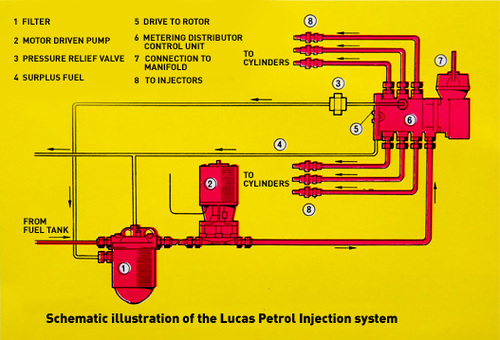
The Lucas MK 2 system worked according to a different principle, as an electric pump maintained the fuel pressure and a distributor calculated the quantity of fuel required by the engine, which it sent to each injector in turn.
A schema of the Lucas MK 2 system on the TR 5 PI (Triumph documents)
40 years later
At the time, this injection system that was deemed to be unreliable, gave some garage owners a lot of work. Today, opinions are divided on the subject. Some swear by Lucas and have few problems; others use Bosch (for the fuel pump), which seems to have solved the recurrent vapour lock problem. The purists sing the praises of carburettors!
In conclusion, the system seems to display a certain capriciousness in that it often works differently from one car to another!
Any experience and information on this system would be welcome to help owners who have difficulty finding the right setup. Don’t hesitate to send us your tricks of the trade/articles and share your ups and downs on the forum!
A big thanks to Philippe Boursin for his kind collaboration.